Zero-Trust Security on AWS: A Practical Implementation Guide
By Cloud IT Providers Engineering Team
The traditional "castle-and-moat" security model is dead. For years, organizations relied on a hardened network perimeter—firewalls, VPNs, and IP allowlists—to keep bad actors out while implicitly trusting every user, device, and service operating inside the internal Virtual Private Cloud (VPC).
In cloud-native environments, reachability is not permission. A compromised credential, a vulnerable container, or a lateral movement exploit can give an attacker free reign inside a trusted network segment.
Zero-Trust Architecture (ZTA) shifts defense from broad network boundaries to continuous, granular verification. On AWS, Zero-Trust is built on three core pillars:
- Verify Explicitly: Always authenticate and authorize based on identity, context, and data payload—never on IP address or network location alone.
- Use Least Privilege: Limit user, service, and machine access using Just-In-Time (JIT) credentials and scoped access policies.
- Assume Breach: Minimize blast radiuses using micro-segmentation, encryption at rest and in transit, and real-time behavioral monitoring.
1. Zero-Trust Architecture Overview
A modern AWS Zero-Trust architecture combines Identity-Aware Ingress for human users and Identity-Aware Micro-Segmentation for internal service-to-service communication.
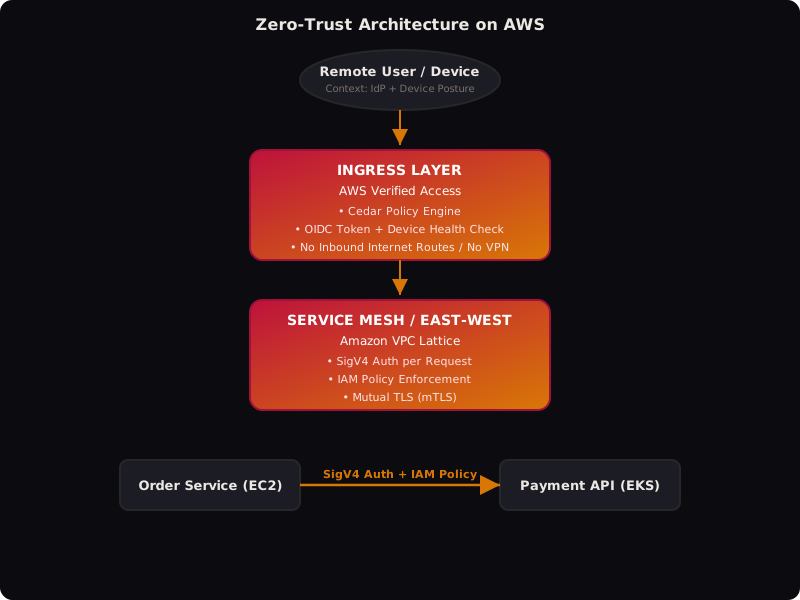
Rather than granting open network access via a corporate VPN, external users connect through AWS Verified Access, which evaluates real-time posture before proxying traffic. Internally, microservices talk through Amazon VPC Lattice, which forces IAM SigV4 signature validation on every inter-service HTTP request.
2. Ingress Security: VPN-less Access with AWS Verified Access
Traditional VPNs grant broad IP routing across internal subnets once authenticated. AWS Verified Access eliminates VPNs by acting as an identity-aware proxy sitting in front of web applications.
Verified Access evaluates user context from an Identity Provider (Okta, Entra ID, or AWS IAM Identity Center) alongside device health signals (CrowdStrike, Jamf) using Cedar security policies before forwarding traffic to private internal endpoints.
3. East-West Security: Micro-Segmentation via Amazon VPC Lattice
Once traffic enters your cloud environment, internal service-to-service communication must be explicitly authorized. Relying solely on security groups leaves applications exposed if an attacker compromises a single container or host.
Amazon VPC Lattice provides identity-based micro-segmentation without needing complex sidecar proxies. Service requests are authenticated and authorized on a per-request basis using AWS IAM policies and AWS Signature Version 4 (SigV4).
4. Machine Identities & Non-Human Access
Zero-Trust applies equally to workloads, scripts, CI/CD pipelines, and AI agents. Long-lived AWS access keys represent one of the single largest credential exposure risks in modern cloud security.
1. Eliminating Static Credentials via AWS STS
Never store long-lived access key pairs in developers' workstations, GitHub repository secrets, or configuration files. Use short-lived credentials generated by AWS Security Token Service (STS).
- For Workstations: Use AWS IAM Identity Center CLI authentication (
aws sso login), which issues temporary tokens bound to user sessions. - For External CI/CD (GitHub Actions / GitLab CI): Use OpenID Connect (OIDC) identity federation to allow CI/CD runners to assume temporary IAM roles dynamically.
2. Machine Identity for AI Agents and Compute Workloads
Assign dedicated, tightly-scoped IAM execution roles to individual ECS tasks, EKS service accounts (IRSA/Pod Identity), and AI workloads. Ensure AI agents and background workers carry independent service identities to restrict data store access to the exact parameters necessary for execution.
5. Continuous Verification & Threat Detection
- AWS KMS: Enforce ubiquitous encryption for data at rest across all storage assets. Customer Managed Keys (CMKs) must restrict decryption permissions explicitly via key policies.
- Amazon GuardDuty: Employs machine learning to analyze VPC Flow Logs, AWS CloudTrail events, and EKS audit logs in real time.
- AWS Security Hub & EventBridge: Automate incident containment. When GuardDuty flags an anomalous role assumption, an EventBridge rule triggers an automated Lambda function to revoke active STS sessions immediately.
6. Phased Implementation Roadmap
| Phase | Duration | Core Deliverables | Focus Area |
|---|---|---|---|
| Phase 1 | Month 1 | Centralize access in AWS IAM Identity Center. Enforce FIDO2/Hardware MFA. | Workforce Identity |
| Phase 2 | Months 2–3 | Deploy AWS Verified Access for high-value web apps. Deprecate legacy VPN tunnels. | Perimeter Elimination |
| Phase 3 | Months 4–5 | Migrate inter-service traffic to Amazon VPC Lattice. Apply IAM Auth policies. | Micro-Segmentation |
| Phase 4 | Month 6+ | Enable AWS Config compliance auto-remediation, ABAC, and GuardDuty automated responses. | Continuous Governance |
Summary
Implementing Zero-Trust on AWS requires aligning identity management, network segmentation, and continuous monitoring into a unified security architecture. By removing implicit network trust, leveraging temporary credentials via STS, securing service-to-service communication with VPC Lattice, and proxying external access through AWS Verified Access, organizations can limit blast radiuses and ensure robust security across every workload.