Why Most Cloud Migrations Fail and How to Get Yours Right
By Cloud IT Providers Engineering Team
Industry research paints a sobering picture of enterprise cloud transformations: according to Gartner, nearly 60% of cloud migration initiatives underperform, stall, or run into severe budget overruns. Meanwhile, McKinsey reports that over 75% of cloud projects exceed their original financial forecasts.
Yet, despite high failure rates, organizations continue to pour billions into the cloud. Why? Because the problem rarely stems from the cloud platforms themselves. The underlying cause of cloud migration failure is almost always operational: poor dependency mapping, misaligned organizational structures, uncalculated total cost of ownership (TCO), and a failure to modernize culture alongside infrastructure.
The gap between a flawed migration plan and a resilient cloud environment comes down to strategy. Here is an architectural blueprint detailing why cloud migrations stall—and how engineering leaders can navigate the journey successfully.
1. The Anatomy of Migration Failure: The 4 Structural Blindspots
Organizations typically treat cloud migration as a pure technical infrastructure lift. In reality, moving to the cloud is an organizational redesign. Failure usually boils down to four critical structural blindspots:
1. The Unmapped Dependency Web
Migrating a single application looks simple on a dashboard until it is deployed in a remote VPC and breaks because it relies on an unmapped legacy database, an on-premises authentication provider, or a forgotten licensing server. High latency across hybrid networks quickly renders the application unusable.
2. Confusing Rehosting with Modernization
A "Lift-and-Shift" migration moves physical tech debt directly into virtual environments. Running over-provisioned, monolithic architectures in the cloud 24/7 retains old architectural issues while significantly increasing operational costs.
3. Missing the Total Cost of Ownership (TCO) Target
Cloud billing is variable and usage-based, unlike the fixed capital expenditure (CapEx) model of on-premises hardware. Organizations often overlook hidden operational costs, such as:
- Inter-region data transfer and egress fees.
- Dual-run infrastructure costs during long migration windows.
- Unbudgeted licensing models (e.g., BYOL implications for legacy database engines).
4. Operational Inertia
Handing cloud infrastructure to teams trained strictly in legacy sysadmin practices inevitably leads to bottlenecks. Without continuous deployment pipelines, automated security guardrails, and cloud-native monitoring, systems fall into disrepair post-migration.
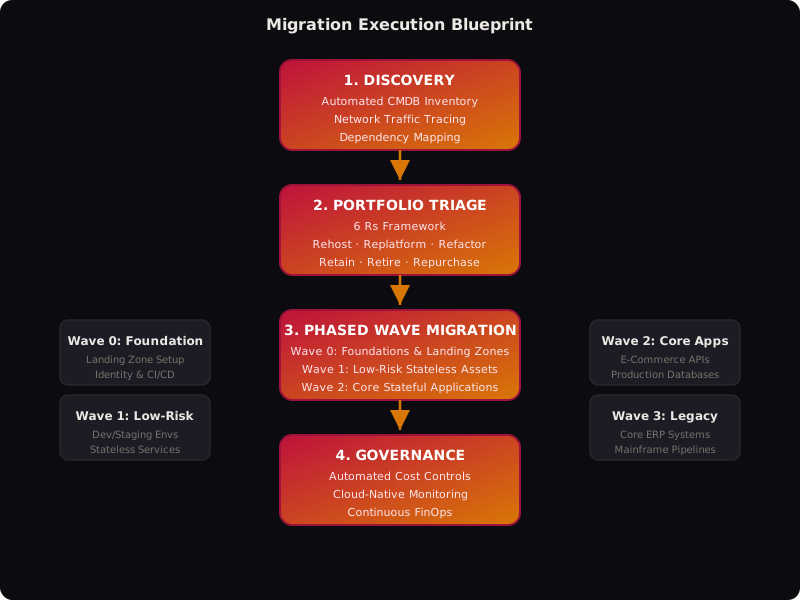
2. The Migration Execution Blueprint
To successfully execute a cloud transformation, engineering teams should structure their migration around a proven framework: Discover, Align, Migrate, and Govern.
3. Step 1: Automated Discovery & Dependency Mapping
Never rely on static spreadsheets or outdated documentation to map your application architecture. Modern discovery requires agent-based or network-level traffic tracing to identify real-time inter-service calls.
Using automated discovery scripts or configuration management databases (CMDB), build a dynamic dependency matrix before scheduling any application wave.
4. Step 2: Portfolio Triage using the "6 Rs"
Not every application belongs in the cloud, and those that do require different strategies. Evaluate your portfolio using the 6 Rs of Migration:
| Strategy | Action | Target Workload | Effort vs. Value |
|---|---|---|---|
| Rehost | Copy VMs as-is to cloud infrastructure. | Data center eviction deadlines, COTS apps. | Low Effort / Low Immediate Value |
| Replatform | Upgrade OS or switch to managed DB with minimal code changes. | Standard Web/App tiers, SQL databases. | Medium Effort / Medium Value |
| Refactor | Rewrite app to leverage microservices, serverless, or containers. | Business-critical, revenue-driving platforms. | High Effort / High Long-Term Value |
| Repurchase | Replace custom software with SaaS equivalents. | HR systems, CRM, email platforms. | Low Effort / High Value |
| Retain | Keep applications on-premises. | High-latency legacy mainframes, regulated data. | Zero Effort / Preserves Baseline |
| Retire | Decommission useless servers and endpoints. | Zombie VMs, legacy dev environments. | Low Effort / Instant Cost Reduction |
5. Step 3: Land Securely with Cloud Foundations
A major cause of migration failure is launching applications into a flat, poorly configured cloud account. Before migrating any production workloads, establish a Cloud Landing Zone using Infrastructure-as-Code (IaC).
A secure landing zone mandates:
- Multi-Account Hierarchy: Isolate production, staging, and shared services using accounts managed via AWS Organizations or Azure Management Groups.
- Centralized Networking: Route traffic through a Hub-and-Spoke VPC architecture (e.g., using AWS Transit Gateway) to prevent chaotic peering setups.
- Identity Federation: Bind cloud platform roles directly to your Enterprise Identity Provider (Okta, Entra ID) using SAML/OIDC.
6. Step 4: The Phased Wave Model
Attempting a "Big Bang" migration where an entire data center flips to the cloud over a single weekend is a primary driver of high-profile migration failures. Successful transformations use a Phased Wave Model:
- Wave 0 (Landing Zone & Sandbox): Build automation pipelines, configure IAM roles, deploy security logging tools, and validate connectivity.
- Wave 1 (Low-Risk Pilot Workloads): Migrate non-critical stateless workloads, dev environments, or internal batch jobs. Use this wave to refine runbooks and train team members.
- Wave 2 (Production Workloads): Migrate revenue-driving applications, utilizing managed database replication services to minimize cutover downtime.
- Wave 3 (Legacy & Complex Data Systems): Modernize, lift, or retain complex dependencies, mainframes, and tightly coupled databases.
Summary Roadmap for Engineering Leadership
| Actionable Objective | Key Deliverable | Success Criteria |
|---|---|---|
| Map Dependencies | Run automated network flow analysis. | Zero unmapped back-end service dependencies prior to cutover. |
| Apply the 6 Rs | Classify every application in your portfolio. | Clear assignment of workloads to Rehost, Replatform, Refactor, or Retire. |
| Build Landing Zone | Automate multi-account VPC setups via IaC. | Centralized identity, network routing, and security guardrails active on Day 1. |