Cloud Migration Strategy: Lift-and-Shift vs. Re-Architecting — When to Choose What
By Cloud IT Providers Engineering Team
Migrating applications to the cloud is no longer a question of if—it is a question of how. Yet, many cloud initiatives stall, balloon in cost, or fail to deliver expected performance gains. Why? Because organizations often treat cloud migration as a singular action rather than a strategic decision.
Not every workload demands a total cloud-native rewrite, just as blindly copying physical infrastructure into cloud virtual machines rarely yields true cloud value. The most successful engineering teams adopt a framework to evaluate their portfolios and apply the right strategy to the right application.
Here is a practical, architectural guide to navigating the choice between Lift-and-Shift (Rehosting) and Re-Architecting (Refactoring)—and how to build a decision framework for your organization.
1. Defining the Strategies
Before comparing trade-offs, let's establish precise technical definitions for the primary migration pathways.
Strategy A: Lift-and-Shift (Rehosting)
Lift-and-Shift takes an application, its dependencies, and its underlying OS image and moves them directly to cloud infrastructure (IaaS) with zero to minimal modifications to the core codebase or architecture.
- Primary Compute Target: Cloud Virtual Machines (e.g., AWS EC2, Azure VMs, GCP Compute Engine).
- Database Target: Self-hosted database engines running inside VMs or minimal transitions to equivalent managed SQL instances.
- Core Value Proposition: Speed, low operational friction, and rapid data center exit.
Strategy B: Re-Architecting (Refactoring / Rebuilding)
Re-Architecting involves modifying an application's design and underlying code to leverage cloud-native features, microservices patterns, serverless paradigms, and fully managed platform services (PaaS).
- Primary Compute Target: Managed Containers (AWS EKS, Azure AKS), Serverless Functions (AWS Lambda, Azure Functions), or PaaS Application Engines.
- Database Target: Cloud-native distributed databases (AWS Aurora, DynamoDB, Google Cloud Spanner).
- Core Value Proposition: Elastic scalability, continuous availability, reduced management overhead, and optimized long-term unit economics.
2. In-Depth Technical & Operational Breakdown
To choose effectively, engineering leadership must weigh both short-term execution risks and long-term operational costs.
| Metric / Dimension | Lift-and-Shift (Rehosting) | Re-Architecting (Refactoring) |
|---|---|---|
| Time to Market | Fast: Weeks to a few months. | Slow: Months to over a year per major workload. |
| Upfront Engineering Cost | Low: Requires migration scripts and infra provisioning. | High: Requires dedicated software development sprints. |
| Operational Overhead | High: You manage OS updates, patching, and VM scaling. | Low: Offloaded to cloud providers via PaaS/Serverless. |
| Scalability | Vertical / Coarse: Scaling up VM sizes or basic autoscaling. | Horizontal / Granular: Micro-scaling individual microservices. |
| Vendor Lock-in Risk | Low: Standard OS and VM images port easily between platforms. | Moderate to High: Deep integration with proprietary cloud SDKs. |
| Fault Tolerance | Dependent on traditional HA patterns (Active/Passive failover). | Cloud-native design (Multi-AZ, stateless workers, self-healing). |
3. The Decision Framework
To remove emotional bias from architectural decisions, evaluate every candidate application against the key vectors outlined below.
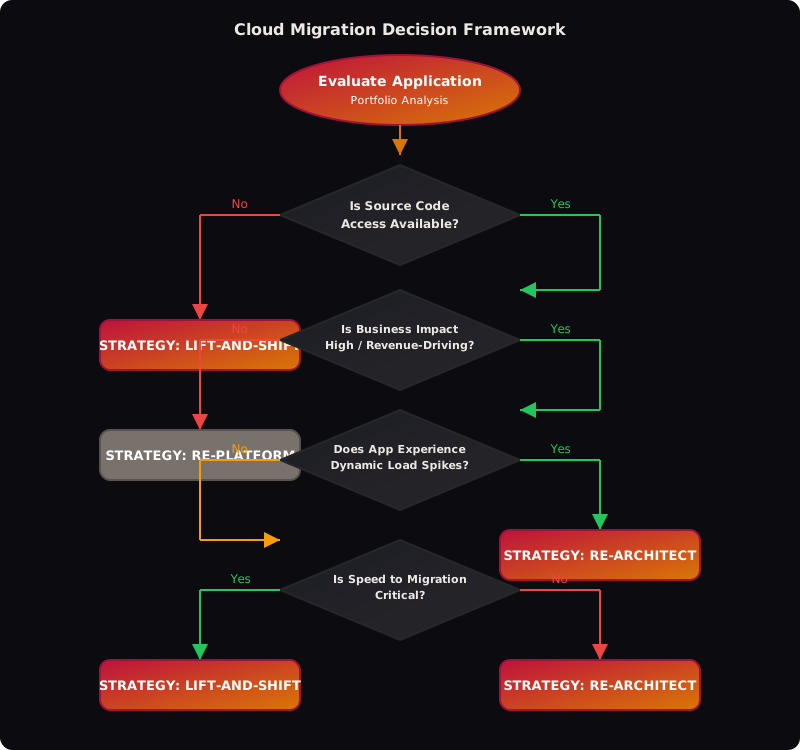
Evaluation Criteria
- Code Modifiability & Ownership: Do you own the source code? Are your teams fluent in the language and framework? If not, Lift-and-Shift is your default starting point.
- Volatility of Demand: Calculate the peak-to-average compute ratio. If an app runs at 10% capacity overnight but demands 900% capacity during peak hours, Re-Architecting pays for itself quickly through auto-scaling savings.
- Business Value vs. Life Expectancy: If an application has a projected operational lifecycle under 2 years, investing engineering capital into Re-Architecting yields a poor Return on Investment (ROI).
Conclusion: Strategic Coexistence
Cloud migration is not a binary choice. The most effective cloud programs leverage a hybrid migration model:
- Rehost (Lift-and-Shift) secondary, supporting, or legacy workloads to exit physical data centers cleanly.
- Re-Architect core, customer-facing engines to unlock enterprise agility, elastic scaling, and continuous release pipelines.
By establishing a clear framework upfront, engineering organizations can move fast without creating unmanageable cloud infrastructure costs down the road.